






























2025 Military-Themed PRO-PLOW™ 3 Auction to Benefit Camp Hometown Heroes
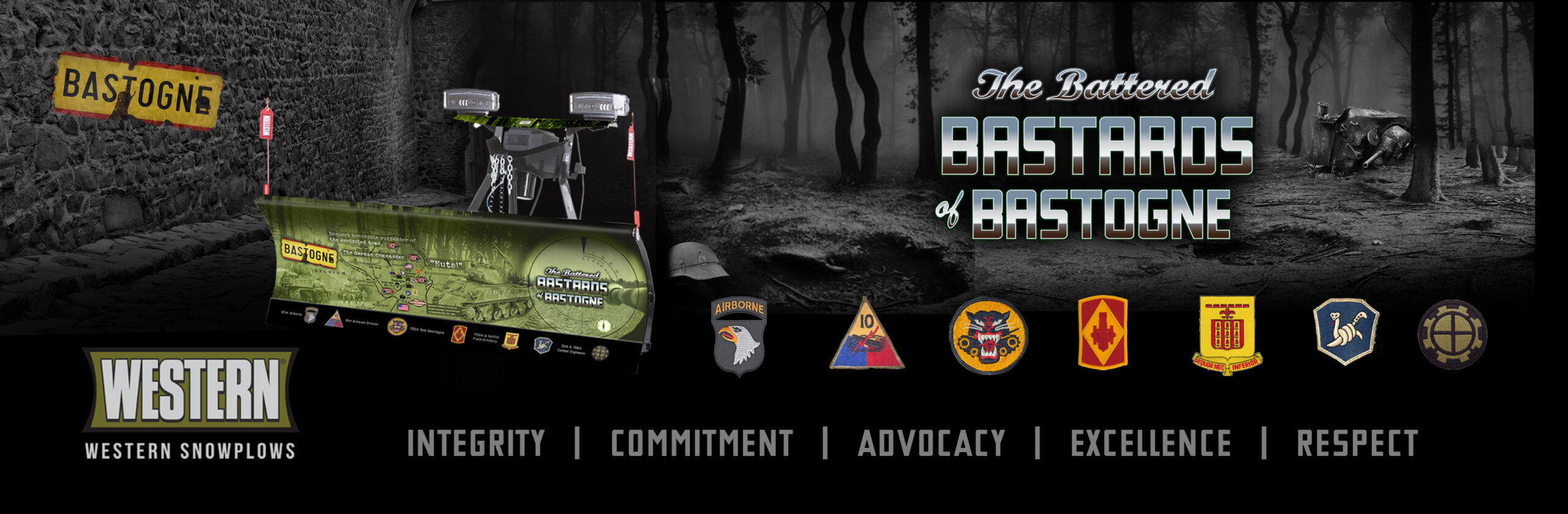
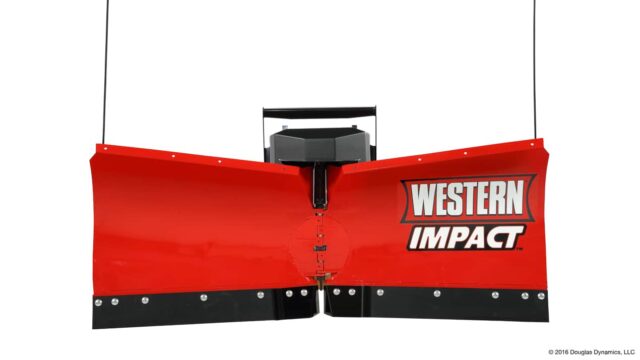
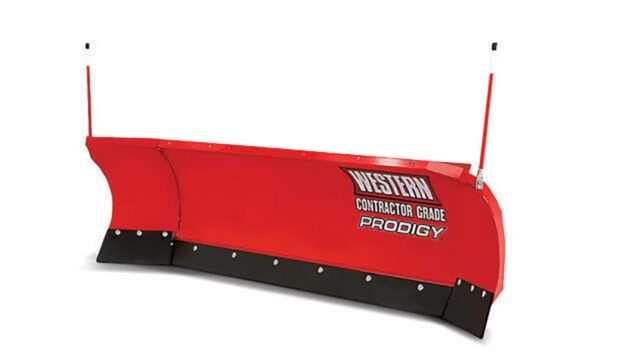
Western Products has partnered with Camp Hometown Heroes to design a one-of-a-kind military-themed plow for Veteran’s Day. This year we have put together a specialty PRO-PLOW 3, honoring the 1944 Battle of Bastogne.
Auction Ended November 11, 2025.
This one-of-a-kind military plow was auctioned off on the WESTERN Facebook page. Gene Storks from Stork’s Plows placed the winning bid of $11,777. All proceeds are donated to Camp Hometown Heroes.
ABOUT CAMP HOMETOWN HEROES
Auction proceeds will be donated to Camp Hometown Heroes, a free week-long overnight summer camp for children and siblings of fallen U.S. Service Members. During their visit to camp, the children begin the healing process with peers who have experienced a similar loss while doing the summer activities that they love. To learn more about this amazing organization, visit the Camp Hometown Heroes website.
Significance of Drawing Time
The auction concludes on Veterans Day, November 11, to honor military veterans. This day coincides with other holidays including Armistice Day and Remembrance Day, which are celebrated in other countries that mark the anniversary of the end of World War I. Major hostilities of World War I formally ended at the 11th hour of the 11th day of the 11th month of 1918, when the Armistice with Germany went into effect. At the urging of major U.S. veteran organizations, Armistice Day was renamed Veterans Day in 1954.
The Story of the Battle of Bastogne
The Battle of Bastogne was a pivotal and brutal engagement within the larger Battle of the Bulge in December 1944, where the American 101st Airborne Division and other forces successfully held the vital Belgian road hub of Bastogne against a massive German offensive, famously responding to a surrender ultimatum. Their tenacious defense disrupted the German advance, allowing Allied forces to regroup and ultimately crush the German counteroffensive.
December 16, 1944
German Offensive Begins:
The German army launched a surprise
winter counteroffensive to break through the Allied lines in the Ardennes Forest with initial attacks focusing on American forces, including those defending Bastogne, Belgium.
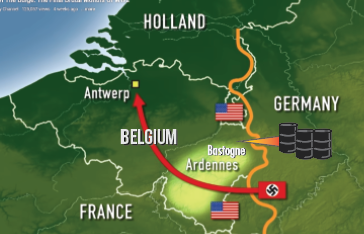
Pivotal Road Hub: Bastogne was a critical road junction, controlling access to several roads vital for troop and supply movement, making it a key objective for both sides.
Germans needed to advance their offensive and seize Allied supply centers, including fuel dumps, further west.
December 17 – 19, 1944
101st Airborne Arrives: The 101st Airborne Division is rushed to Bastogne to bolster the defense, arriving in the early hours of December 19, shortly after other armored and infantry units.
These troops were ill-equipped for the German surprise attack during the harsh winter. They faced extreme shortages of supplies and specialized winter gear while surrounded by a numerically superior enemy.

The soldiers were deployed with standard-issue gear, which was insufficient for the freezing temperatures that dropped to -4 degrees Fahrenheit or lower. Many suffered from frostbite and trench foot due to a lack of proper winter boots and socks.
American forces had limited ammunition, especially for their mortars and artillery. The 101st was also an airborne unit, lacking heavy armored vehicles, though they were supplemented by elements of the 10th Armored Division.
The besieged troops ran dangerously low on medical supplies, including blood plasma and medicine. Field medics would be forced to perform life-saving procedures with whatever makeshift tools were available.
In addition, the American troops faced dwindling food shortages.
December 20 – 21, 1944
Bastogne is Encircled: German forces surround the town, cutting off the main road and isolating the Allied defenders within Bastogne. The attack created a “bulge” in the Allied lines.
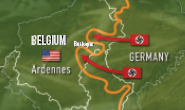
U.S. forces in and near Bastogne have been encircled by strong German armored units. More German armored units have crossed the river Our near Ortheuville, have taken Marche and reached St. Hubert by passing through Hompre-Sibret-Tillet.
As the battle unfolded, American infantry divisions along the German border fought fiercely, while fresh troops like the 99th and 106th Infantry Divisions were brutally hit by the German onslaught. Engineers operated windmills for wood, built fortified protections, and prepared demolitions.
In the north, some troops held their ground tenaciously, while others were overrun. Atrocities were committed by SS troops of the 6th German Panzer Army, leading to a shift in the main attack to the 5th Panzer Army area.1
In the central Ardennes, Bastogne became a focal point, surrounded by German divisions. The battle, fought under harsh conditions with temperatures feeling like minus 28 degrees Celsius, resulted in high casualties on both sides. The American forces, surrounded and facing brutal weather, displayed remarkable resilience and determination.
The strategic importance of Bastogne was its location at a critical road junction in the Ardennes, which the Germans needed to advance their offensive and seize Allied supply centers, including fuel dumps, further west.
Allied fuel depots were located in other Belgian towns and cities, such as Stavelot and Spa. German plans depended on capturing these supplies to sustain their advance toward the port of Antwerp.
During the Battle of the Bulge:
The German offensive failed to capture needed fuel crippling the German advance. Early on, Kampfgruppe Peiper captured some American fuel in towns like Honsfeld. However, the Allies denied the Germans fuel. German forces led by Colonel Joachim Peiper advanced toward the towns of Stavelot and Spa outside of Bastone.
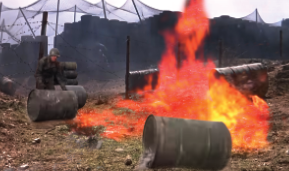
German forces discovered Allied soldiers and Belgian civilians had set fire to a massive 2.5-million-gallon fuel depot, creating a seven-mile-long wall of flame. This was a critical factor in their failure to achieve their objectives.
Bastogne’s defense was vital. By holding Bastogne, the 101st Airborne Division and other American defenders blocked access to the roads needed by the Germans to resupply and reinforce their troops, further frustrating the offensive.
December 22 – 26, 1944
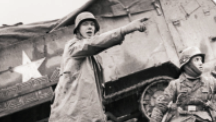
The seige by German forces of the strategically vital town of Bastogne lasted for about ten days, with the German assault intensifying.
In desperation, the Germans sent a surrender ultimatum to BG McAuliffe, the acting commander of the 101st, on 22 December.

In knowing the strength of his position, the quality of his men, and the likelihood of resupply, BG McAuliffe gave a short reply to the German ultimatum …
 "To the German Commander, NUTS!

      - The American Commander.”
The two blindfolded German officers were then driven, again by a roundabout route, back to their entry point at the Kessler farm. At the farm, the group was rejoined by PFC Premetz. The blindfolds were removed and the Germans opened and looked at the reply. They asked, “What does this mean?” They obviously didn’t understand the American slang. Harper and Premetz discussed how to explain it. Harper suggested, “Tell them to take a flying s**t!” Premetz thought about it, then straightened up, faced the Germans and said, “Du kannst zum Teufel gehen.” He told Harper it meant “You can go to Hell.”
Despite McAuliffe’s confidence, the situation in Bastogne was becoming critical as the supply of ammunition, food, and medical supplies was desperately low as the Germans had cutoff resupply by road and the weather had not permitted an aerial resupply.
The next day, the situation improved as the weather cleared, allowing aerial resupply and close air support to assist the Screaming Eagles. Further relief came when on 26 December, leading elements of Patton’s Third Army made contact with the 101st. With the encirclement broken, the 101st quickly began receiving resupply by both ground and air and the wounded could be evacuated.
Operational challenges
Beyond the physical equipment, other factors hindered the American defenses.
Surprise offensive: The German attack, known as the Battle of the Bulge, caught the Allies completely off guard in the heavily forested Ardennes region, where the American lines were thinly spread.
Poor weather: Fog and low clouds at the start of the battle grounded the superior Allied air forces for several days. This prevented aerial resupply and attacks on German positions, worsening the supply situation for the surrounded soldiers.
Dispersed Leadership: The 101st Airborne’s commander, Major General Maxwell Taylor, was not present at the start of the siege. Command fell to the acting division commander, Brigadier General Anthony McAuliffe.
Despite these formidable challenges, the American forces displayed exceptional bravery. They effectively used the terrain to establish a defensive perimeter and held out against overwhelming odds until they were relieved by General Patton’s Third Army. The supply situation improved significantly on December 26, 1944, when the weather cleared, and Allied planes began successfully dropping supplies and munitions
The American paratroopers held Bastogne, fighting off German armor and infantry assaults while enduring heavy artillery and bombing from the Luftwaffe.
Relief: Supplies were delivered by air, and the siege was broken on December 26, 1944, when General George S. Patton’s Third Army arrived after a rapid counterthrust, relieving the defenders.
Outcome
American Victory: The defense of Bastogne was an American victory, crucial in halting the German offensive and restoring the front in the Ardennes.
Significance: The successful defense of Bastogne significantly disrupted German strategic plans and demonstrated American resilience, ultimately leading to the failure of the Battle of the Bulge.
Additional Stories
Battle of Bastogne Jacket Seen on Pawn Stars
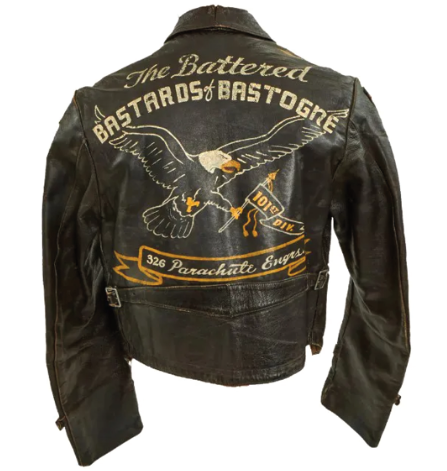
Gillian’s father collected vintage leather jackets, and she came across this one while helping him clean out some closets. She thought it was a biker jacket from WWI or WWI, and was hoping to get at least $1,000. Gillian brought it to the Gold & Silver Pawn Shop, which is prominently featured on the show Pawn Stars. There she was greeted by Chumlee, who agreed that while it was a cool jacket, something was off.
“Looking at the patches, I don’t think this would’ve been a motorcycle jacket but maybe like a pilot’s jacket,” he said. During the First World War, fighter pilots were the first to wear leather jackets. By WWII it became an essential part of their uniform to endure the extreme cold at high altitudes.
What struck him as odd was that the jacket had more of a European cut than the traditional American style. He had a military memorabilia specialist come in to take a closer look at the jacket and figure out what was going on. Alex Cranmer, the chief executive officer of International Military Antiques, was blown away by the jacket. He explained that Battered Bastards of Bastogne was a reference to The Battle of the Bulge, the parachute troop named is who jumped at Normandy, and the eagle was clutching a flag that reads “101st div” as a tribute to the 101st Air Borne division.
“If you’re going to have something from WWII that is referencing an American victory, it’s Bastogne or Normandy, but this is both,” Alex said.
“It’s a one-of-a-kind piece and it is fantastic,” Alex added. He gave a final appraisal of $12,000.
Gillian was blown away, but unfortunately, Chumlee didn’t think anyone in the store would buy it for its true value and encouraged her to auction it instead. Ultimately, the jacket ended up selling at Alex’s International Military Antiques for an unknown amount.
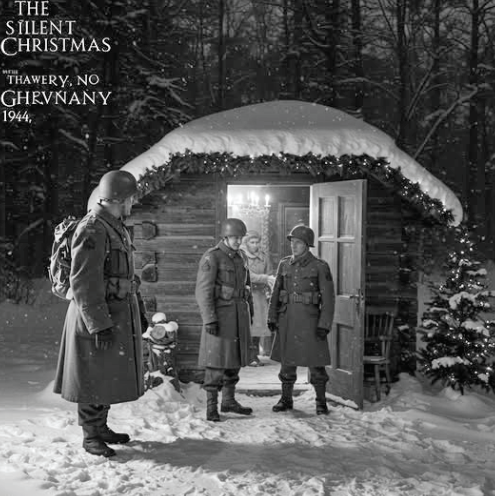
The Silent Christmas
The phrase “Lost Americans Christmas dinner Bastogne” likely refers to two distinct stories from the Battle of the Bulge during Christmas 1944: one where a Belgian family hosted a small group of lost American soldiers for a meal, and another where a Belgian family sheltered American soldiers who were joined by German soldiers for a shared, peaceful Christmas dinner. The phrase “lost Americans” can refer to the soldiers who were separated from their units, the members of the besieged 101st Airborne Division, or the Germans who found themselves at the Vincken family’s home, far from their own lines.
Story 1: Lost Americans with a Belgian family
Three American soldiers, lost from their unit, found a Belgian farmhouse. The family, including a mother, father, and their children, took them in and shared a meal of soup and black bread. They spent Christmas Eve together, singing Christmas carols despite the war raging outside.
Story 2: American and German soldiers share a Christmas meal
This story involves a Belgian family, the Vinckens, who sheltered three lost American soldiers. On Christmas Eve, four German soldiers also sought shelter at the same farmhouse. The American and German soldiers, initially tense, put their weapons aside after the family’s mother insisted. The two groups shared a Christmas meal together in a temporary, unspoken truce, a moment of peace amidst the battle. The next morning, the German soldiers gave the Americans a compass and directions to find their unit before returning to their own lines.
This story is documented in Fritz Vincken’s memoir, Readers Digest, January 1973, pp. 111-114.